F-01
All-Weather IPX5 Build
IPX5 sealed · −5°C to 50°CSealed motors, IPX5-rated electronics, and corrosion-protected chassis run through dew, light rain, summer dust, and salty coastal air without ducking back into a depot.

From transport hubs and park pathways to multi-storey car parks, industrial estate roadways and warehouse loading docks, the FloorBotics Max 100 and Quad 1100 fleet delivers all-weather coverage, digital cleaning records, and dock-and-go autonomy for consistent day-to-day site operations.
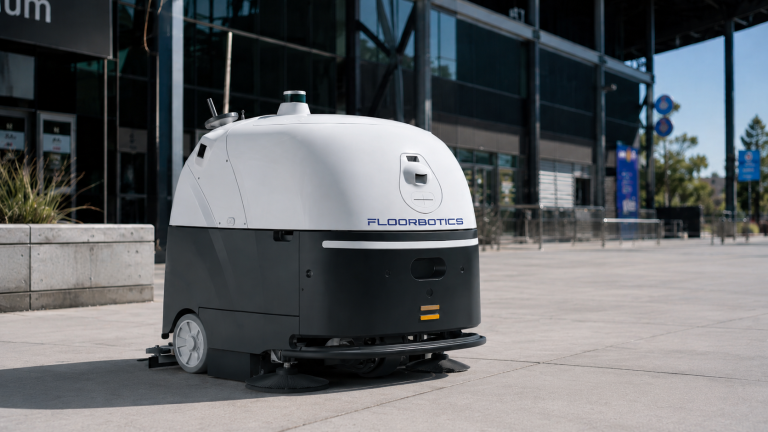
Transport hubs, terminal forecourts, park pathways, multi-storey car parks, industrial estate roadways, and warehouse loading docks are the largest, hardest-working, and most weather-exposed surfaces an operator manages — and the first place a slip claim or community complaint will land. Manual sweep crews and ride-on sweepers cannot keep up at the frequencies modern WHS, environmental, and amenity expectations now require.
Public-liability claims arising from outdoor pedestrian areas, car parks and footpaths cost Australian operators more than a billion dollars a year. Wet, gritty, oil-stained or leaf-littered hardstand is the leading contributor.
Most site and facility cleaning specifications call for daily sweep cycles on high-amenity zones; reality is closer to weekly. Manual ride-on sweepers cover a fraction of the kilometres of footpath, road, and dock apron that need attention every shift.
Site managers, operations teams, and WHS stakeholders increasingly expect evidenced sweep and scrub frequency — not a sign-off sheet on a clipboard at the depot.

When a site manager, regional representative, WHS reviewer, or insurance assessor walks your site, the loading apron, the kerbside, and the car-park entry tell the truth before any policy does. Fluid trails near dock levellers, leaf litter on stormwater grates, gravel on pedestrian crossings — these are the first signals of a non-conformance finding. FloorBotics produces time-stamped proof-of-clean records for every square metre swept and scrubbed — every shift, every day.
Six capabilities mapped directly to the WHS, environmental, amenity, and asset-protection scorecards a facility or industrial-park operator already runs.
Sealed motors, IPX5-rated electronics, and corrosion-protected chassis run through dew, light rain, summer dust, and salty coastal air without ducking back into a depot.
Every swept and scrubbed square metre is time-stamped, GPS-tagged, and exportable for site reporting, maintenance planning, and operations review.
Works safely around shoppers, joggers, prams, kerbside diners and forklift traffic. Geo-fences keep robots clear of playgrounds, water features, and active loading lanes during peak hours.
Quad 1100 captures oil, hydraulic fluid and detergent residue at source; Max 100 lifts grit, leaves and gravel before it reaches stormwater grates — protecting receiving waterways and site asset condition ratings.
Pressure, brush count, water flow and dwell time are tuned for concrete, asphalt, brick paver and tactile-indicator surfaces to reduce slip-risk conditions across changing weather.
Manage multiple cleaning robots from one central console across large sites, multi-building facilities, car parks, warehouses, public spaces and commercial precincts. Teams can monitor machine activity, receive key alerts and review cleaning status without checking each robot separately.
Max 100 handles large-area sweeping and vacuuming, and Quad 1100 manages high-capacity hardstand and dock programs at up to 4000 m²/h. Run both from one console with reporting.

Every sweep and scrub cycle generates a GPS-tagged record with coverage map, time stamps, brush and water-flow telemetry, and any skipped zone with an operator escalation log. Reports can be shared in common digital formats and connected with your CMMS, GIS, or BMS workflows.

A 62,000 m² industrial estate — eight DCs, 4.2 km of internal roadways, and 14 loading docks — co-deployed alongside a transport interchange forecourt and pedestrian plaza on its boundary. Two Max 100 sweepers and two Quad 1100 scrubber-sweepers ran a 90-day pilot. The results reshaped both budgets and operational outcomes.
“We bought the fleet for the labour offset. What we didn’t expect was how quickly site presentation and consistency improved — or local operations teams calling out our adjoining interchange forecourt as one of the cleanest pedestrian surfaces in the area.”
Source: 90-day pilot report, Q2 2026. Reviewed internally by the precinct operations team and local liaison stakeholders. Full document available on request.
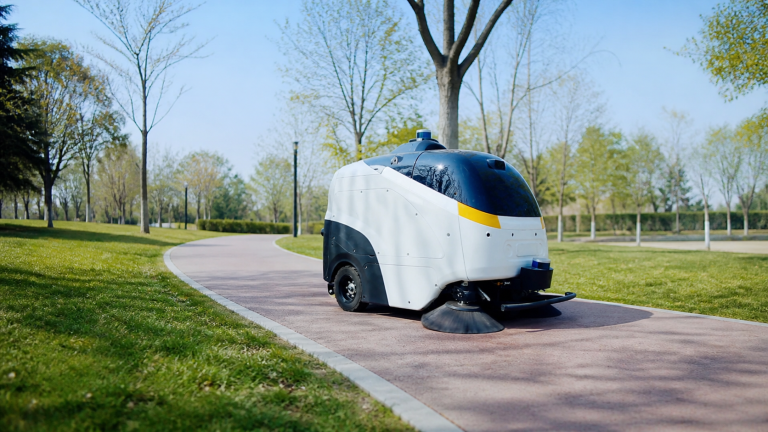
Max 100 is positioned as the primary autonomous commercial sweeping and vacuuming platform for large outdoor and open areas with heavy dust, debris and refuse exposure. It should be positioned as a sweeper and vacuum product, not as a scrubber-first model.
Quad 1100 is used for higher-capacity scrub-sweep programs across heavy-use hardstand and dock environments where larger tank and battery configuration is required.
Yes. The fleet supports reporting workflows with coverage and operation records for site management and contractor governance.
A FloorBotics outdoor specialist walks your site alongside your operations, parks, or facilities lead, maps your highest-risk hardstand and pedestrian areas, and returns a staged Max 100 + Quad 1100 deployment plan with ROI modelling — at no cost.